From a Big Intention to One Visible Next Step
Turn a big intention into one visible next step: make the action small enough to choose, clear enough to notice and easy to revisit together.
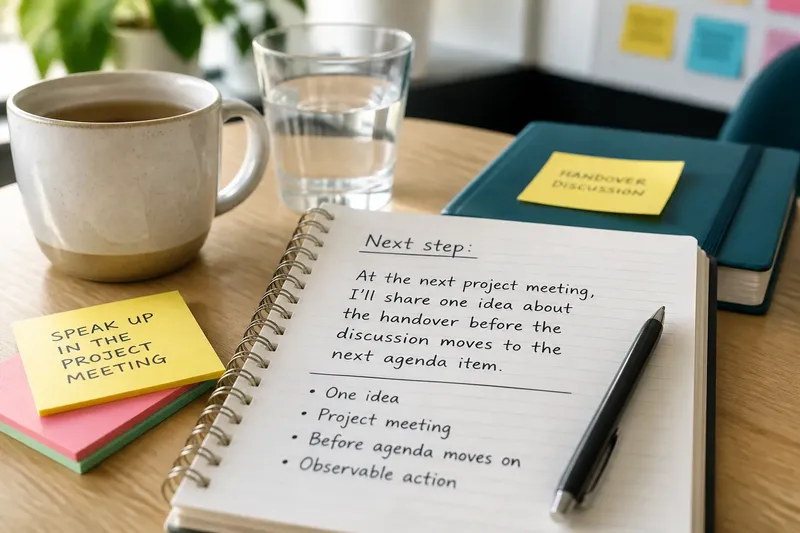
“I want to feel more confident speaking up at work” is a real intention, but it is hard to act on before the next meeting. A visible next step turns that broad aim into something the person can choose, do and recognise afterwards. In coaching, the point is not to shrink the ambition; it is to give it a first foothold.
What is hidden inside the big intention?
Imagine that Maya, a fictional project coordinator, brings this aim to a coaching conversation: “I want to be more confident at work.” She says she often leaves meetings with useful ideas still in her notebook. The intention matters to her, but “be more confident” is a quality, not an action. There is no clear moment when she could say she has done it.
The coach does not need to define confidence for Maya or decide what she should do. Instead, they help her locate the aim in an ordinary scene. Which work moment makes the intention feel relevant? What would she like to be different there? Maya chooses the weekly project meeting, where she tends to wait until the discussion has moved on.
That choice gives the conversation a setting without prescribing an outcome. The next task is to discover what “speaking up” could mean in that setting. It might mean asking a question, naming a concern, offering an idea or requesting time to think. Those are distinct actions, and Maya gets to decide which one fits.
How does the intention become observable?
The coach asks Maya what a colleague could actually see or hear if she acted on her intention. She first says, “I’d contribute more.” The phrase still leaves room for guesswork: more than when, and what counts as a contribution?
They narrow it by staying close to the meeting scene. Maya settles on: “At the next project meeting, I’ll share one idea about the handover before the discussion moves to the next agenda item.” Now the action has a place, a cue and a visible form. It does not promise that colleagues will agree, or that Maya will suddenly feel confident. Those outcomes are outside her control.
This distinction keeps a goal usable. A person can choose to ask a question, make a suggestion or send a message. They cannot choose another person’s response, the room’s mood or whether an idea is adopted. A well-shaped next step focuses on the person’s own move while leaving the result open.
“One idea” is not a magic formula. Another person might choose to say one sentence, ask for a turn, or raise a concern after the meeting. The useful measure is whether the action is specific enough for the person to recognise, yet natural enough to feel like theirs.
What makes the next step small enough to choose?
A step can be visible and still feel too large. If Maya’s plan were to lead the whole meeting, she might see no comfortable way to begin. A smaller action preserves direction while lowering the demand: contribute one prepared thought during a familiar meeting.
Small does not mean trivial. The action should matter to the person and connect to the wider intention. If it is so slight that it has no personal meaning, it may become an exercise performed for the coach rather than a choice made by the person. Ask what makes this move worth trying.
There is also a difference between a small action and a vague one. “Try to be braver” is modest in tone but gives no clear cue. “Ask whether the handover owner has been confirmed” is concrete, although Maya may decide that this question is not the contribution she wants to make. Precision should support choice, not replace it.
Say Maya notices that she tends to lose her thought when the agenda changes. She chooses to write one sentence on her meeting notes beforehand and bring it to the handover discussion. The expected observable result is simply that she either says the sentence during that discussion or does not. That makes the action easier to revisit without treating either outcome as a verdict on her confidence.
How can the action stay the person’s choice?
Coaching can slip into advice when a coach recognises a familiar problem. “You should send the team a note first” may sound helpful, but it can move ownership away from the person. A better prompt is, “What options feel workable to you?” The coach can offer ideas if invited, while making clear that Maya chooses whether any fit.
Choice also includes permission to revise. Maya might decide that speaking in the meeting is not the right first move, or that the topic has changed. The coach can ask what she wants now, rather than defending the original plan. A next step is a working decision, not a contract to ignore new information.
Useful questions stay close to the person’s language:
- “Which part of this aim matters most to you right now?”
- “What could someone see or hear you do?”
- “What would make that action feel manageable in the setting you named?”
- “Is this the step you want to choose, or does another option fit better?”
- “What might make it harder, and what would you like to do if that happens?”
These are not prompts to run through mechanically. One well-timed question can give the person room to make a decision. If the coach asks too many in a row, the conversation can begin to feel like an interview rather than a shared effort to clarify an aim.
How will Maya revisit the step?
Before they finish, the coach and Maya agree when to return to the action: at their next conversation, after the project meeting. They do not need to decide in advance what success will mean. They can first ask what happened, what Maya noticed and what she wants to do with that information.
If she shares her idea, the review can distinguish the action from its reception. Did she say the sentence she chose? What was it like to do so? If the team moves on before she speaks, the review can look at the circumstances and her next preference, without turning the moment into a character judgement.
If the meeting is cancelled or the handover discussion never arises, the action has not had its intended setting. That is useful context, not evidence of failure. Maya can choose whether to carry the same action into another meeting, reshape it or leave it aside.
This makes revisiting more than a scorecard. The action gives the next conversation something concrete to examine, while the person remains free to interpret what it meant. A coach can help notice patterns, but should not claim that one attempt proves a lasting change.
What questions help shape a visible next step?
What is a visible next step in coaching?
It is an action the person can recognise in a particular situation, such as asking a colleague a question or offering one idea in a meeting. It is not a feeling or a result controlled by someone else.
How small should a coaching goal be?
Small enough that the person can picture choosing it, but meaningful enough to connect with the broader intention. The person’s own sense of readiness matters more than an outside rule about size.
What if the person cannot name an action yet?
Stay with the scene and ask what they would notice if things were a little different. They may need time, a clearer sense of what matters or a different conversation before choosing a step.
Should a coach set a deadline for the action?
A time or event can help make a step concrete, but it should be agreed with the person and suit the situation. A chosen cue, such as the next project meeting, is often clearer than a date imposed by the coach.
What is not worth forcing?
Do not polish the wording until it sounds like a formal performance target if the person’s own language is clearer. Nor is it useful to build a detailed plan for every possible obstacle before the person has chosen an action. A little preparation can help; elaborate planning may turn a manageable choice into another burden.
In Maya’s case, the movement is from “be more confident” to a sentence she chooses to bring to one meeting. The change is modest but meaningful: she can tell what she intends to do, decide whether it still fits and later describe what happened. For anyone shaping a big intention into a visible next step, the practical test is simple: can the person name the action, choose it freely and recognise it when the moment comes?