The Five-Minute Review: What a Coaching Conversation Can Leave Behind
A five-minute review of a coaching conversation helps you separate decisions from open questions and keep a clear record without creating more homework.
You leave a coaching conversation with a page of notes, a decision still pending and a practical question: what should you keep? A five-minute review of a coaching conversation can turn the session into a useful record without grading your performance or replaying every exchange.
What should the review record?
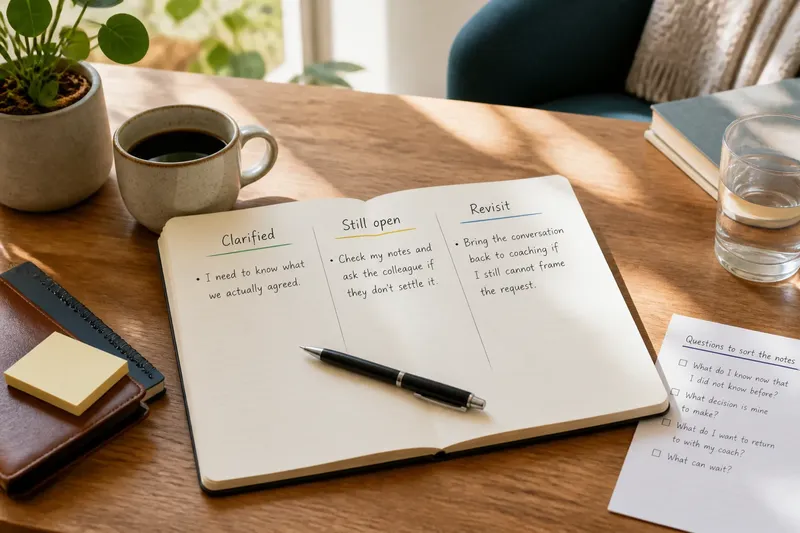
Give the page three separate jobs: record what became clearer, preserve what remains undecided and choose what to revisit. This is less a report on how the conversation felt than a small handover to your future self.
- Clarified: What do you understand now that you could not state as clearly before?
- Still open: What decision, fact or conversation remains outstanding?
- Revisit: What would be useful to bring back to coaching, or to consider on your own?
Use fragments. “I need to check whether the new shift clashes with childcare” is easier to act on later than a page of general impressions. Keep separate what you know, what you suspect and what you have yet to decide.
What is not worth the effort? Reconstructing the conversation word for word or scoring every question. Those tasks produce a transcript or a verdict, not a clear record of what remains to be done.
How can you tell a decision from an open question?
A decision is something you have chosen. An open question marks information or agreement you still need. Do not turn uncertainty into a promise just to make the page look complete.
Say you discussed whether to accept an extra shift. Your starting point is a message asking for an answer, and you know the shift may overlap with a family commitment. You write “Still open: check the diary, then decide whether to accept”; after checking, you can record the choice or note what still prevents one. The result is a clear next point, not a decision made prematurely.
If the issue involves employment, health, money or another consequential matter, use coaching notes to clarify your own questions, not as a substitute for qualified professional advice where that is needed.
What belongs in a five-minute review of a coaching conversation?
Use the possible results of each note to decide what to do next. This short checklist is a sorting tool, not a demand to finish every item:
- Observation: You can state a new understanding in one plain sentence. If it is clear, record it under “Clarified”; if it is still a hunch, mark it as uncertain instead.
- Observation: A decision depends on a fact you have not checked. If you know where that fact is, note the source and check it; if you do not, write what information or person you need to identify.
- Observation: You have chosen what to do. If the choice is settled, record it as a decision; if you are still weighing options, keep it under “Still open”.
- Observation: A topic needs more conversation. If you want to return to it with your coach, note the topic and what you want from that discussion; if you would rather handle it elsewhere, identify the person or support that fits.
- Observation: You cannot tell what the next note means. If you can rewrite it as a question or choice, do so; if it remains vague, leave it unresolved rather than inventing an answer.
- Observation: You have written several possible next actions. If one is necessary to clarify the issue, keep that one; if none is necessary now, record “wait” and stop.
Which questions help you sort the notes?
What do I know now that I did not know before?
Write the new point as a plain statement, and mark any uncertainty honestly. If it depends on a fact you have not checked, put that fact under “Still open” rather than treating it as settled.
What decision is mine to make?
Name the choice without adding pressure to make it immediately. If someone else must provide information or agree to something first, record that dependency too.
What do I want to return to with my coach?
Note the topic and the purpose: for instance, to clarify an earlier point or consider an option you have not discussed. If nothing needs another conversation, leave this part blank.
What can wait?
Separate a genuine deadline from the urge to tidy every loose end. If there is no immediate choice to make, write “revisit later” and avoid manufacturing a task.
How can you keep the review useful without making it homework?
Set a small boundary: one note under each heading, then stop. A notebook, a notes app or a loose sheet will do; choose whichever is easiest to find when you next need the record.
Imagine you have discussed asking a colleague to change a shared task, but you are unsure whether the current arrangement was agreed or simply assumed. You begin with those two facts: the task is shared, and the agreement is unclear. First, you write “Clarified: I need to know what we actually agreed”; next, “Still open: check my notes and ask the colleague if they do not settle it”; then, “Revisit: bring the conversation back to coaching if I still cannot frame the request.” The resulting record distinguishes a missing fact from a possible conversation, without deciding in advance how the colleague will respond.
A five-minute review of a coaching conversation is most useful when it leaves you with an honest distinction: what is settled, what needs checking and what can wait. Keep the note where you can find it, and let the next real decision—not a tidy-looking page—tell you when to return to it.